

How Do Electric Vehicles Work?

For a long time, it seemed like electric vehicles (EVs) were always going to remain the stuff of sci-fi daydreams. Internal combustion engine (ICE) vehicles have had a stranglehold on the consumer market for the last 100-plus years, making it hard to envision a day when they would start to be replaced by a new, greener option. Well, that day has come, or at least appears to be on the horizon, as EV sales represented seven percent of all American vehicle sales in 2023. The EV segment has exploded in popularity in the last few years, with EV registrations increasing by an astounding 60 percent in the first quarter of 2022 alone. We could throw a lot more statistics at you, but the message is clear: EVs have arrived, and they’re a force to be reckoned with in today’s automotive market.
While there’s a lot of excitement around the segment, there’s also a lot of confusion. Familiarizing yourself with an entirely new type of vehicle can be difficult for even the most mechanically minded, leading many to ask the same question: how do electric vehicles work? In short, electric vehicles simply replace the gas-powered motor you’d find in a traditional ICE vehicle with a battery pack and electric motor, but there’s a lot more to it than that. Let’s explore some of the biggest FAQs about the EV segment, examine different EV battery types, and address questions about range, charging, torque, and more in our guide to EV basics.
How Do Batteries and Electric Motors Work?
How do EVs work? As we mentioned, EVs are powered by an electric motor (or multiple motors) that are, in turn, powered by a rechargeable battery pack. When you step on the accelerator, the battery feeds energy to the electric motor, turning the wheels and propelling the vehicle down the road. This differs from plug-in hybrid (PHEV) and traditional hybrid vehicles (HEV), which rely on a gas engine in addition to their rechargeable batteries and electric motors.
In most EVs, the electric motors––known as traction motors––actually perform two functions: moving the wheels and recharging the battery through a system known as regenerative braking. When the regenerative braking system is active, an EV’s electric motors will kick into reverse, recapturing the kinetic energy normally lost in the braking process and converting it into electricity that can be used to recharge the battery pack. This doesn’t produce enough energy to fully recharge the battery but is useful when it comes to topping it off or extending the EV’s range.
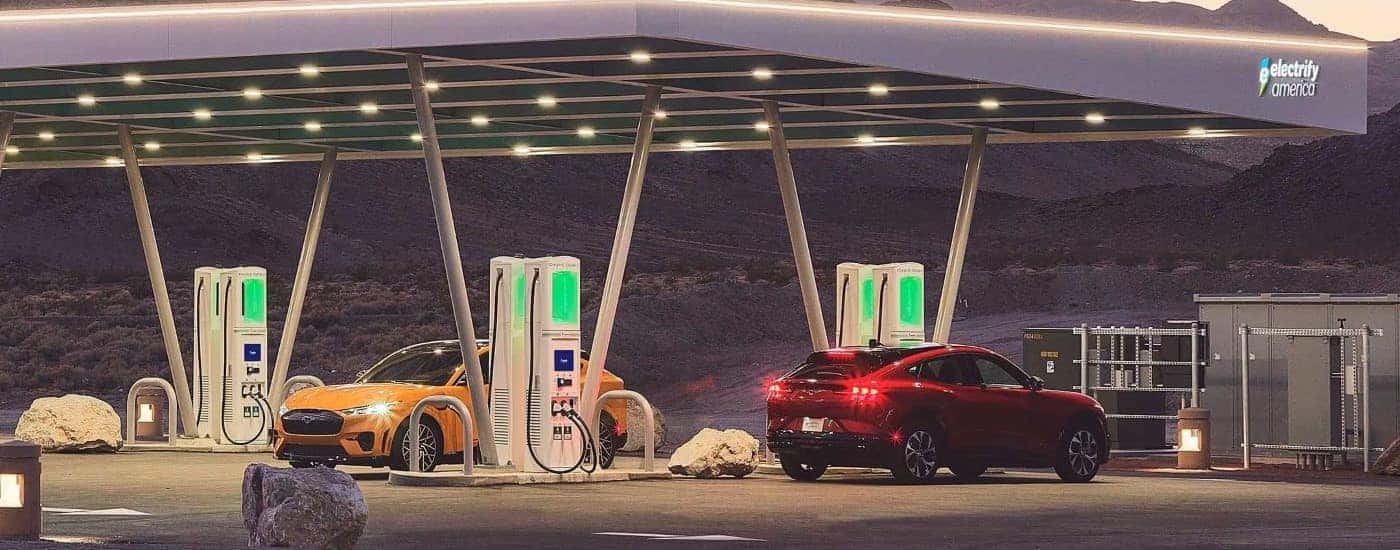
Electric motors and batteries aren’t the only things that differentiate EVs from their gas-powered forerunners. EVs are also built with charge ports that allow them to be recharged by an external power supply, with charging times ranging from 20 minutes to 40 hours based on the type of charging source. EVs also feature onboard chargers, which convert the AC power supplied by charging ports into DC power that can be used to charge the battery pack. In addition to these components, EVs also include a number of parts you won’t find on the average ICE vehicle, such as a DC/DC converter, a power electronics controller, and a thermal management system to keep the battery and other sensitive electronics at the ideal operating temperature.
What Are the Most Common EV Battery Types?
When most drivers think of EVs, they picture a vehicle powered by a large lithium-ion battery like those found in their phones, laptops, and other common consumer electronics. While lithium-ion batteries are undoubtedly the go-to choice for most automakers, there are a few other competing battery formulas on the market. Read on as we break down each type of battery and run through their various pros and cons.
Lithium-ion
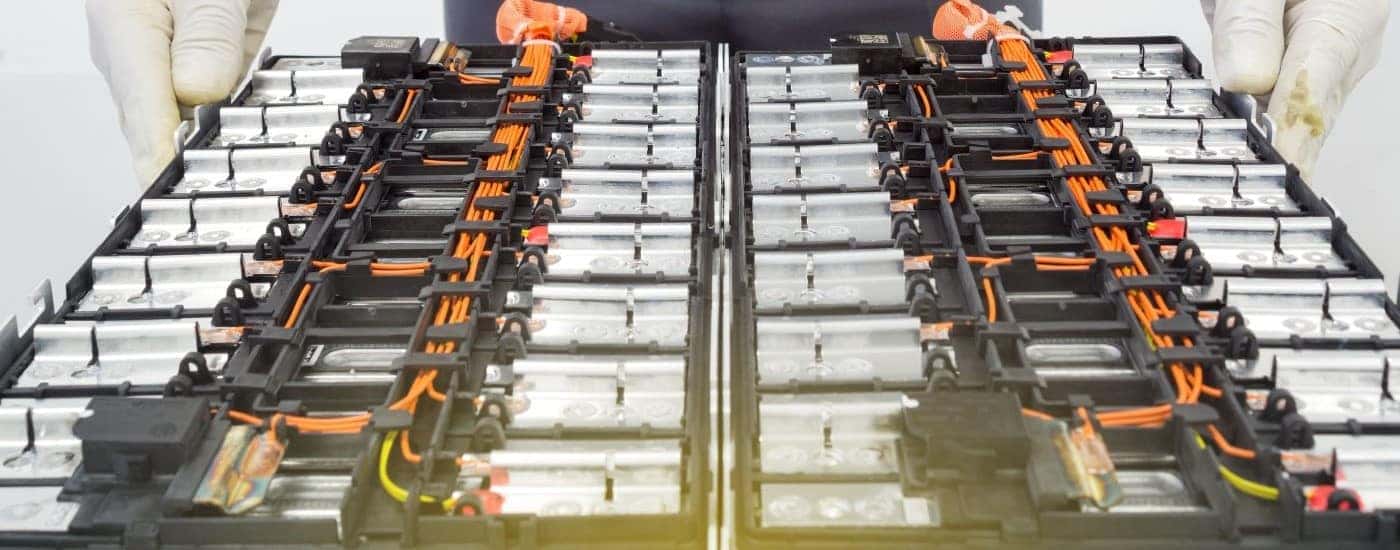
Lithium-ion batteries are the reigning champ in the modern EV market, powering a vast majority of today’s EVs. Lithium-ion is used as a general term, but more often than not, they’re actually composed of either Lithium Cobalt Oxide (LCO) or Lithium Nickel Cobalt Aluminum Oxide (NCA). Another increasingly popular chemistry is Lithium Iron Phosphate (LeFePo), which is less expensive than LCO or NCA. There are a few reasons for the dominance of lithium-ion batteries, but it largely comes down to their high power-to-weight ratio, efficiency, and high-temperature performance.
That said, lithium-ion batteries have come under increased scrutiny in recent years due to the high environmental toll. Lithium is not only difficult and costly to extract but also takes a lot of effort to process, with one ton of refined lithium requiring some 130,000 gallons of water. Nickel and cobalt also come with their own extraction-related drawbacks, which is why the industry is on the hunt for the next generation of battery technology that can replace the problematic lithium-ion standard.
Nickel-Metal Hydride
Nickel-metal hydride batteries are a popular choice for hybrid electric vehicles like the Toyota Prius and Honda Insight, where they are used to power auxiliary systems, reduce engine idling, and give a quick boost to the gas engine when accelerating from a stop. These batteries are less expensive than lithium-ion batteries but tend to release a lot of heat when exposed to high temperatures. Nickel-metal hydride batteries also discharge faster than their lithium-ion cousins, which is an important consideration in an industry where charging times and driving range are such common concerns.
Solid-state
While they might not be quite ready for the spotlight, many predict that solid-state batteries will represent the next big evolution in EV battery technology. Solid-state batteries will have far more energy density than the typical lithium-ion formula, which translates into a smaller, lighter power solution for future EVs. They’re also much easier on the environment, with a 40 percent lower carbon footprint than lithium-ion offerings. The first solid-state-powered vehicles could hit the streets by 2025, with Toyota, BMW, and Ford all experimenting with the technology. With an expected driving range of double that of today’s average EV, solid-state batteries should go a long way in addressing the range-related anxiety that many EV drivers are faced with.
Lead-acid
Lastly, there are lead-acid batteries. If that name sounds familiar, it’s probably because that’s the same type of 12-volt battery you’ll find under the hood of most gas-powered vehicles. However, lead-acid batteries have also been used in some of the industry’s earliest EVs, like the GM EV1 and the Ford Ranger EV from the 1990s. Lead-acid batteries have lots of limitations, from low specific energy and poor cold-weather performance to a relatively short service life, which is why they’re not found powering the electric motors of today’s EVs. That said, lead-acid batteries can still be found in some EV models where they’re used to power auxiliary features and provide backup power for the power steering, brake boosting, or safety systems.
How Powerful are Electric Vehicles?
EV performance has come a long way since the earliest all-electric models made their debut in the late 1800s. Just take William Morrison’s “electric carriage” from 1890, which logged just four horsepower and had a top speed of 14 mph. Of course, that’s not really a fair comparison given the era, but EVs have trended in an upward trajectory ever since.
The Nissan LEAF is commonly cited as the first mass-produced EV of the modern age, but these early EVs were generally more focused on proving themselves in terms of efficiency rather than raw power. Still, the 2011 LEAF was a marked improvement over some previous EV attempts, with 107 hp, 207 lb-ft of torque, and a top speed of 90 mph. You certainly weren’t going to win any drag races with a zero-to-60-mph time of 10 seconds, but like later EVs to come, the LEAF was able to take advantage of some of the EV powertrain’s unique properties to punch well above its weight when it comes to power.
This boost in power largely comes down to a basic difference in how gas-powered engines and electric motors operate. Gas might still be the most popular choice in today’s market, but there are some inherent inefficiencies to the technology that only become apparent when you start to compare it to EVs. There’s no doubting the raw power that a gas engine can produce, but in order to do so, it needs to get up to an optimal operating range. This requires slowly crawling up through the rev range to 6,000 RPM or more to reach peak power. While drivers are often drawn to a model for its listed horsepower and torque ratings, these figures can only be achieved when the vehicle is in this sort of high RPM range. This issue is even relevant to today’s turbocharged gas engines, which develop peak horsepower earlier but experience turbo lag compared to traditional naturally aspirated models.
How are EVs different? An electric motor delivers all the power it’s capable of the moment you step on the accelerator. Built with single-speed transmissions and offering near-instant torque, an EV doesn’t need to build up to peak power: it’s there right when you need it. This design confers some obvious benefits when it comes to performance, with many EVs providing a thrilling ride that few of their gas-powered competitors can match. An increasing number of EV models are also being built with both front and rear motors, giving every axle its own power source and enabling the sort of traction that makes for some rocket-like launches. Take the Rimac Nevera, for example. This ultra-luxe EV is the current leader in the torque department, with 1,741 lb-ft on call whenever you put your foot to the pedal. That’s good enough for a zero-to-60 mph time of just 1.74 seconds, which puts even the fastest gas-powered model to shame.
As far as horsepower is concerned, EVs don’t tend to outshine gas-powered vehicles quite as much as they do in the torque department. EVs still lag behind ICE vehicles in terms of top speed, and the single-speed transmission makes high-speed acceleration a bit difficult. Still, when it comes to real-world driving applications, these factors tend to be much less important than low-speed acceleration. Think about it: every driver is going to find themselves in a situation where they’re accelerating to merge onto a highway, but few are going to push a vehicle past the 150 mph mark on the open road. EVs simply feel faster to most drivers, largely thanks to the near-instant acceleration provided by the electric motors.
What Determines the Range of a BEV?
EV range has increased dramatically in the last decade. While some early EVs saw their range limited to just 75 miles, today’s average has skyrocketed to almost 250 miles. That’s more than tripled the range in just ten years, showing how fast EV technology is still evolving. But what exactly determines the range of an EV?
Ultimately, it all comes down to the size of the battery and the EV’s average efficiency. Battery size, which is expressed in kilowatt-hours (kWh), averages around 70-80 kWh for the average EV but can grow up to 200 kWh when you’re talking about hard working all-electric pickups like the Chevy Silverado EV or GMC Hummer EV. An EV’s efficiency is also important but will vary depending on driving style, temperature, and a number of other factors. Most EVs will display their average efficiency on a widget in the dashboard gauge cluster, with the typical EV averaging between three to four miles per kWh.
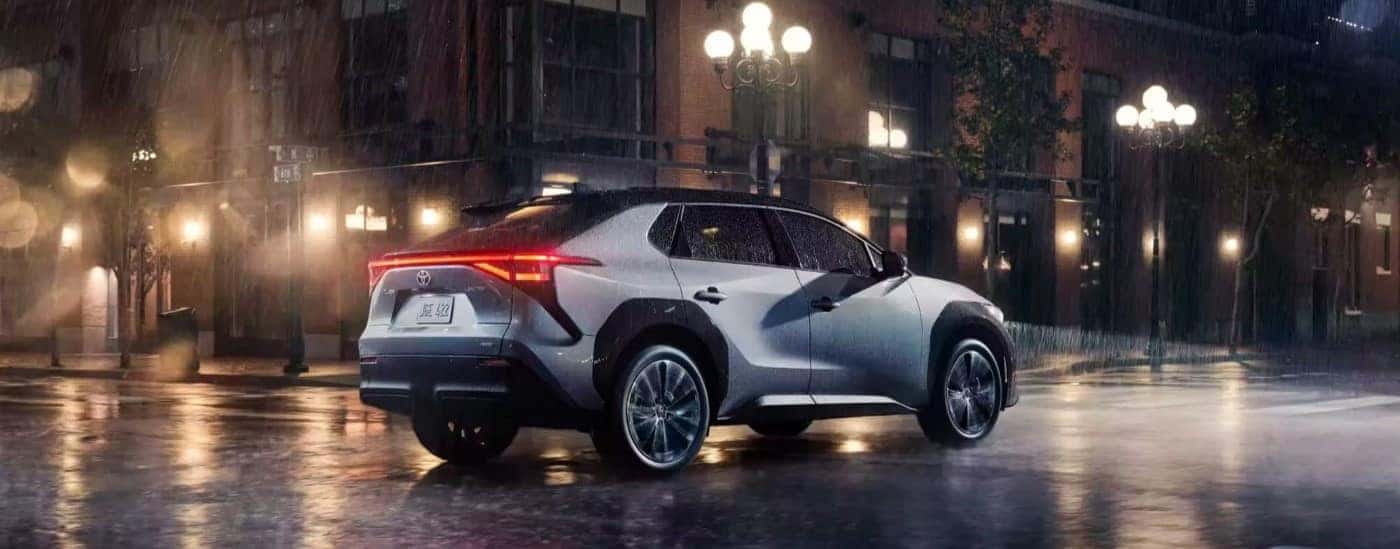
Once you’ve determined an EV’s battery size and average efficiency, it’s just a matter of doing some simple math. Let’s take the 2023 Toyota bZ4x as an example. Toyota’s first all-electric model features a 72 kWh battery and averages 28 kWh per 100 miles, according to EPA testing. That’s an efficiency of 3.6 kWh per mile for an estimated range of 252 miles for the Toyota bZ4x. These days, the longest-ranged EV on offer is the Lucid Air, with an impressive range of 516 miles. This number can largely be credited to the Air’s 118 kWh battery, which gives the four-door sedan plenty of room to roam.

We’re Here to Help You Understand All Things EV
Between range, battery types, and questions about torque and horsepower, there can be a lot to digest when you start exploring the EV segment. All-electric vehicles aren’t going anywhere, so the sooner you can wrap your head around the ins and outs of these new alternative fuel vehicles, the better. We know it can be overwhelming, but Faricy Automotive is here to help you understand all things related to EVs. We have long been a trusted name in the Colorado auto market, and we hope to leverage that history to help guide our customers into the new and exciting world of electric vehicles. From the cost savings and environmental benefits to the unbridled power and pure fun they can provide, EVs are unlike anything the driving public has seen before.
At Faricy Automotive, we’ve fully invested in the electric vehicles segment, building up our inventory with some of the best makes and models on the road to offer our customers a driving experience they won’t soon forget. From new models offering generous range and thrilling power to pre-owned EVs that will help you get a foothold in the segment without blowing your budget, we’ve got the right EV for you, just waiting for you to take it on a test drive. We’ve always seen ourselves as more than just a dealership and strive to give our customers all the information they need to make a decision that fits their own unique needs and style. With so many questions, misunderstandings, and new facts to learn in the EV segment, that educational role has never been more vital than it is right now. We’re eager to demonstrate the myriad benefits of the EV segment and show our customers that the grass––and the vehicles––are greener when you opt for the all-electric approach.